Introduction
In today’s rapidly evolving digital world, many parents are searching for ways to help their children learn English effectively while still ensuring safety and healthy development. EddyBot was created as a new kind of learning companion—one that transforms language learning into a joyful, pressure-free experience rather than a daily obligation.
AI-powered teddy bears are emerging as a new trend in early childhood education, combining the comfort of a familiar toy with the intelligence of modern technology. EddyBot represents this new approach, where learning happens through play, conversation, and emotional connection.

1. EddyBot – A New Way for Children to Learn English
Children between the ages of 3 and 8 are at the ideal stage to absorb new languages naturally. However, screen-based learning through phones and tablets often leads to excessive screen time, eye strain, and dependency on digital devices—issues that increasingly concern parents.
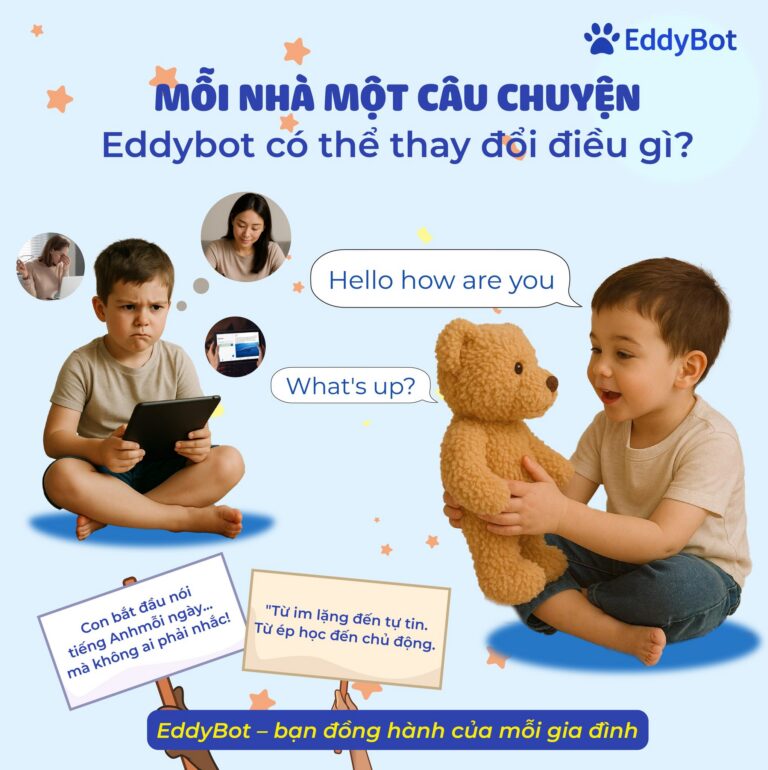
EddyBot offers a safer alternative. Children can learn English through voice interaction without staring at a screen or being exposed to blue light. By talking directly to their teddy bear, learning becomes a natural part of everyday play, allowing English to blend seamlessly into a child’s daily life.
What Makes EddyBot Different from Traditional Learning Methods?
Unlike traditional learning tools or one-way educational apps, EddyBot engages children in two-way voice interaction. Children can ask questions, listen to stories, sing English songs, or respond to prompts designed specifically for their age.
This continuous interaction helps children develop natural language reflexes—something that many conventional learning methods struggle to achieve. Instead of memorizing isolated vocabulary, children learn how to use English in real conversational contexts.
How EddyBot Helps Children Enjoy Learning English
One of EddyBot’s greatest strengths is its ability to make learning fun. Rather than sitting through rigid lessons, children are greeted with friendly conversations, playful mini-games, storytelling sessions, and interactive activities in English.
This friendly and engaging experience helps remove fear or resistance toward learning a foreign language. Over time, English becomes familiar and enjoyable, not something children feel forced to study.

Key Features of EddyBot - Optimized Voice Recognition for Young Children
EddyBot is trained on child-specific voice data, allowing it to accurately recognize children’s speech patterns and respond appropriately. This ensures smooth conversations and helps children feel confident when speaking English.
Detailed Pronunciation Feedback
Pronunciation is often one of the biggest challenges for young language learners. EddyBot analyzes children’s speech by breaking it down into phonetic components and provides immediate, gentle feedback. Instead of criticism, EddyBot encourages and guides children, helping them improve without losing confidence.
Context-Aware Conversations
Unlike basic chatbots that respond to individual sentences, EddyBot remembers the context of the conversation. For example, if a child says, “I like apples,” EddyBot might ask, “Why do you like apples?” or “What other fruits do you like?” This helps children practice real conversational skills rather than repeating disconnected phrases.
Screen-Free (No Screen) Learning Experience
As screen time becomes a growing concern, EddyBot provides a completely screen-free learning environment. Children interact only through voice, protecting their eyesight and encouraging natural communication habits. Learning no longer depends on animations or videos, but on genuine interaction.
Rich and Continuously Updated Learning Content
EddyBot offers a wide range of activities, including storytelling, singing, word-guessing games, role-playing scenarios, quick interviews, and pronunciation practice. New content is regularly updated to keep children engaged and prevent repetition or boredom.
Conclusion
Aenean urna urna – semper sed consectetur sit amet, pretium eu ante. Nulla et consectetur ligula, ut fringilla velit. Interdum et malesuada fames ac ante ipsum primis in faucibus. Nulla sagittis vel ante sit amet tempor. In sit amet neque non tellus interdum tincidunt eget eu odio. Donec quis diam felis. Etiam id quam maximus, tempus justo at posuere est! Morbi nec accumsan sem. Suspendisse eget elit mauris. Phasellus velit nisi, lobortis quis nisi et, venenatis finibus velit. Integer non nibh eget arcu malesuada ullamcorper.